1. Say It
The adult says a few words, models the sounds, and the child blends them. A sound can be changed to make a new word.
The method
Sounds to Stories teaches reading through explicit, step-by-step phonics. Children learn one sound pattern at a time, then read a short story that uses only what they have already been taught.
The program is built so that print always stays within reach. After a new pattern is taught, the child reads words and a short decodable text made from taught sounds and any Heart Words that have already been introduced.
That is what a decodable story is for: the child can sound words out instead of guessing from pictures. An adult still reads a short meaning preview, then the child reads the story to find out what happens.
The 21 Steps follow a planned sequence, from first letters in Step 1 to less common spellings and longer words in Step 21. Sets inside a Step also go in order.

The sample lessons follow the same layout, so a parent or teacher can find each part quickly. Adult directions stay in the “Say It” section, facing the adult. The story and writing page face the child.
The adult says a few words, models the sounds, and the child blends them. A sound can be changed to make a new word.
A short review of the reading skill for that set, with example words.
The child reads decodable words, story words, and any Heart Words for the lesson, pointed out in a mixed order.
A short meaning preview, then the decodable story beside a picture. The child reads to answer a simple question.
A brief conversation about the story, such as who sat, or what happened first, next, and last.
Reread smoothly with connected words. Read again if it helps. The lesson does not time the reading.
Look at each letter, say the sounds, blend, and reread.
Spell words from the lesson, write a dictated sentence, and write a sentence about the story. Check capitals, spaces, an end mark, sense, and handwriting.
Early sets introduce a new pattern with an introductory story. Later in a Step, children also use cumulative practice texts that review several patterns together, still staying within what has already been taught. Heart Words — words with a part to remember for now — begin in Step 2 and are taught explicitly, with a Heart Word Pathway chart.
The program includes visual pathway charts. A sample Syllable Types Pathway chart is free to download. The Decoding Pathway, Heart Word Pathway, and Affix Pathway are part of the program; the images below are previews of those approved charts, not downloadable packets.
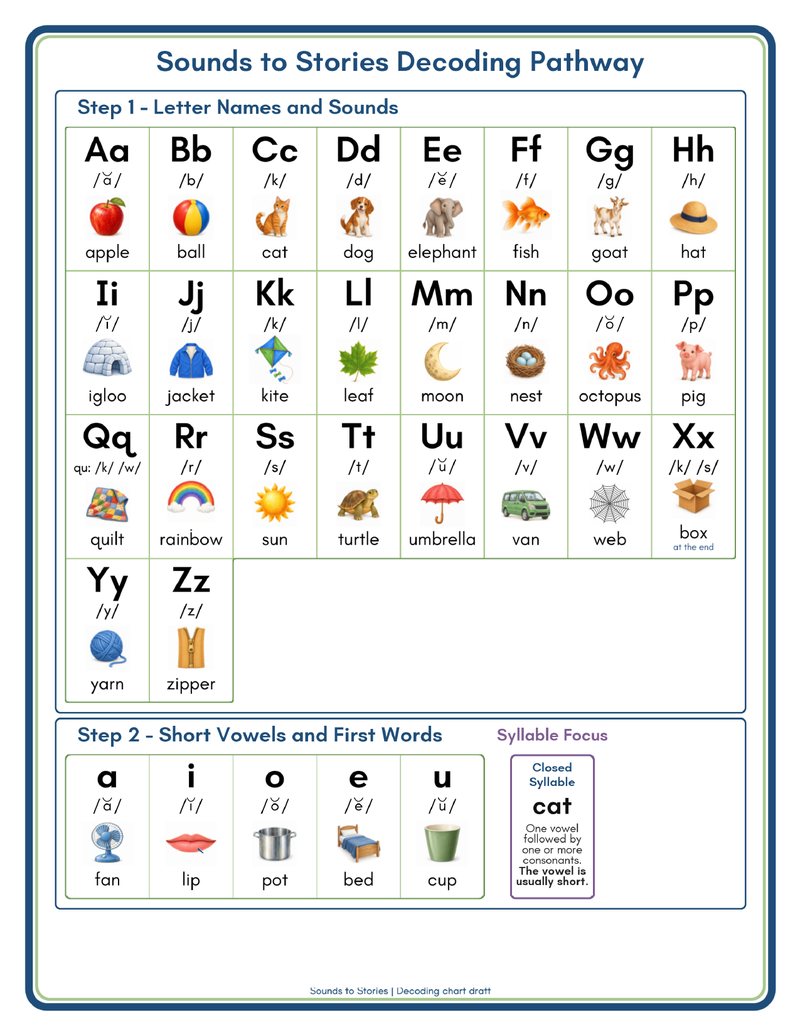
The phonics patterns of the 21 Steps, with syllable-focus examples.
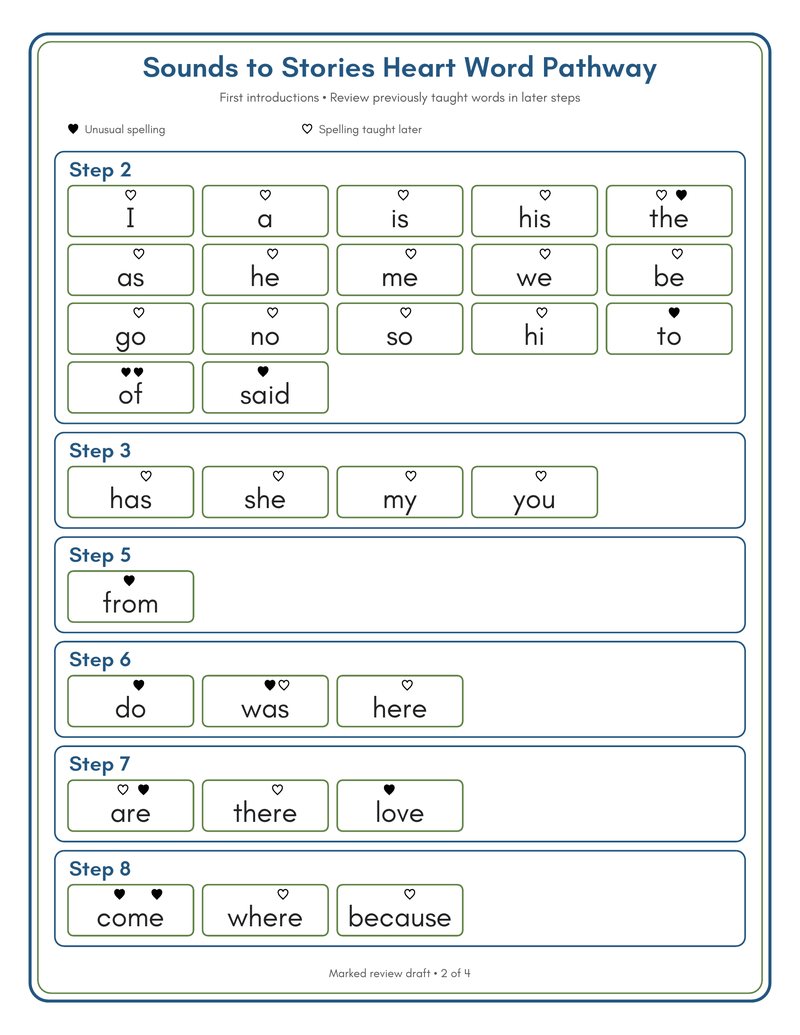
High-frequency words taught with a heart marking for the part to remember for now.
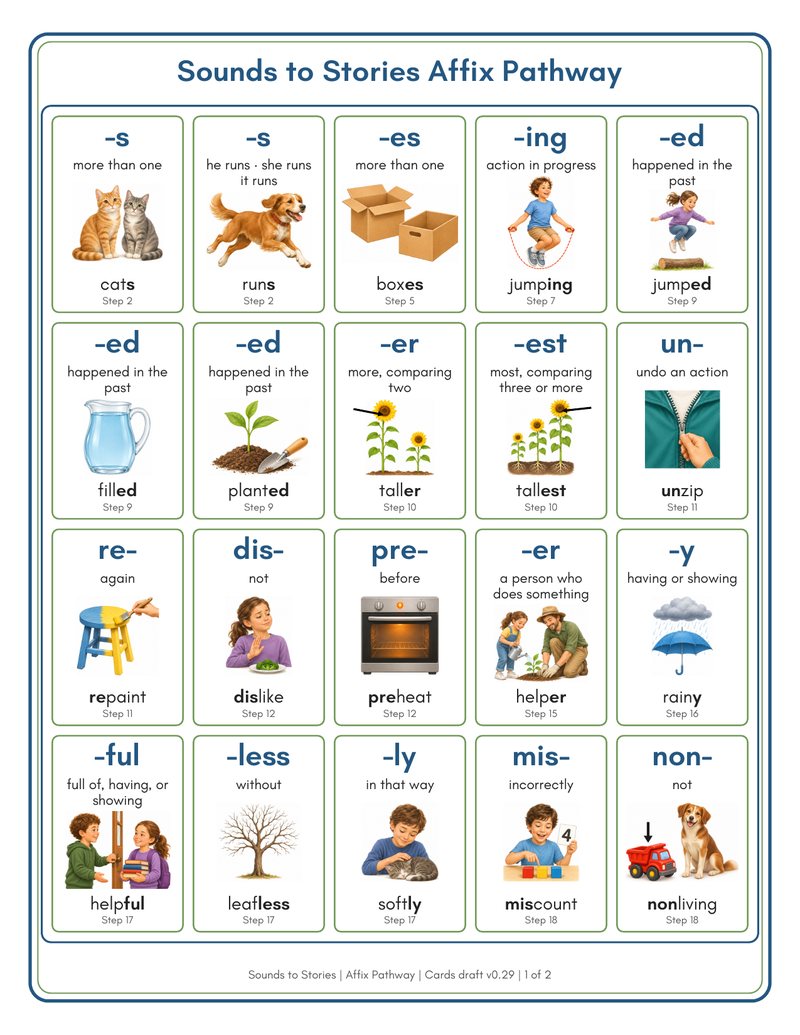
Prefixes and suffixes taught on bases the child can already read.
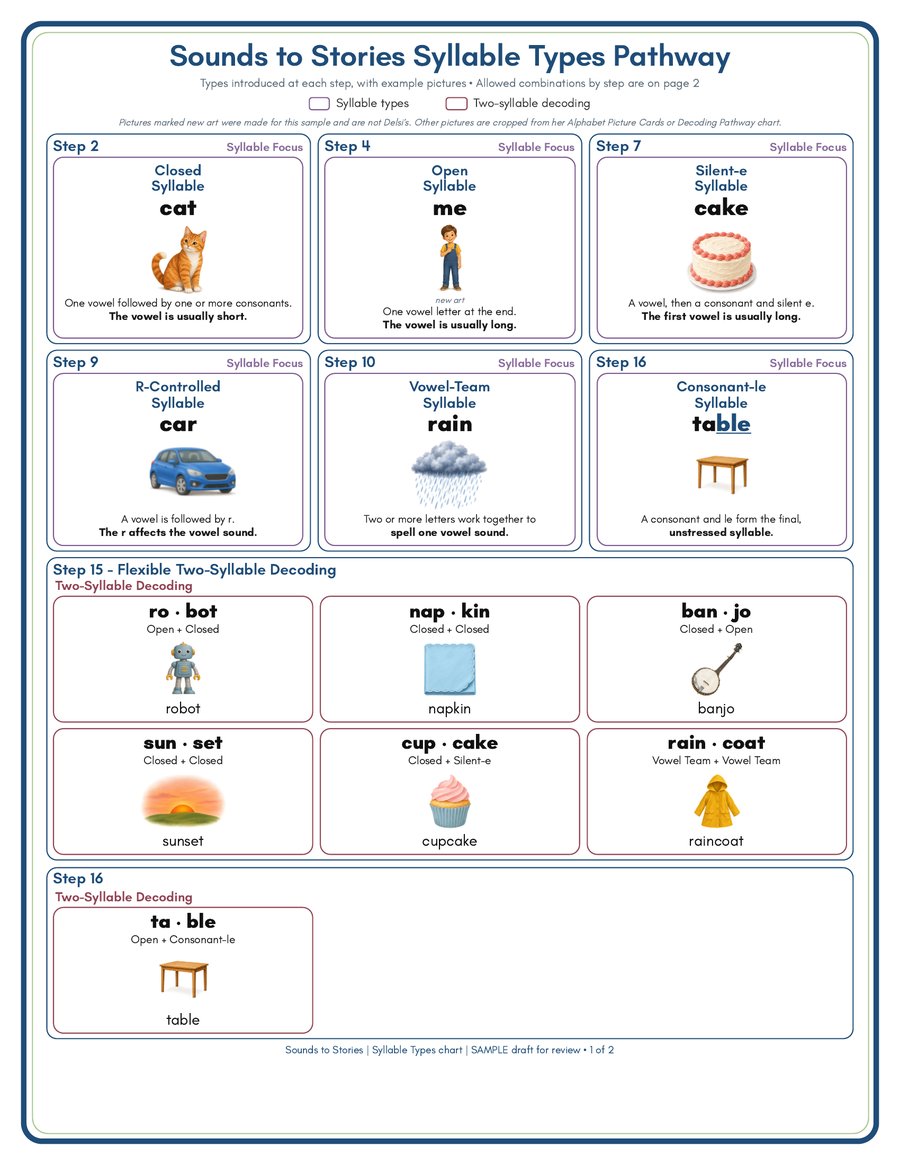
A sample chart of the syllable types and two-syllable combinations taught in the program.
Download the sample chart (PDF)Oral work such as hearing, blending, and segmenting sounds. This work does not, by itself, authorize new printed patterns.
The new letter-sound pattern for the set, taught explicitly, then used in reading and spelling.
Syllable types are introduced at planned Steps, then combined for two-syllable reading.
No formal Heart Words in Step 1. From Step 2 on, selected words are taught with their exact sounds and heart parts.
Children spell taught words, write from dictation, and write about the story, with adult help for untaught words.
Meaningful prefixes and suffixes are added only on authorized bases, at the Steps where they are taught.
Brief sentences in Step 1, then decodable stories and cumulative practice in later Steps.